Design Solidarity?
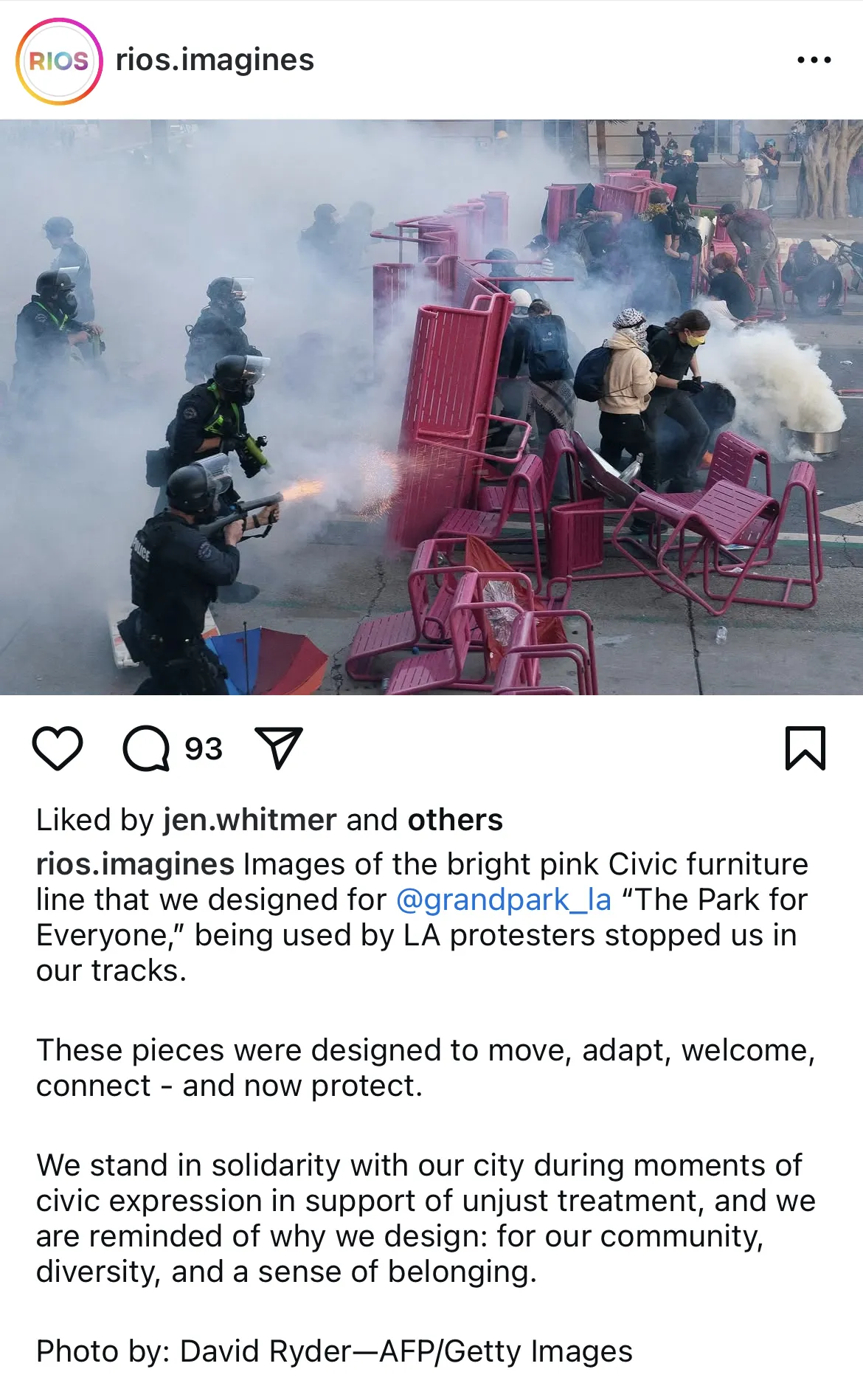
Among the many incredible images that emerged out of the recent LA uprising against ICE deportations was a widely circulated photograph of protesters using bright pink urban furniture as street barricades against riot police. The company that designed the chairs and benches, architecture and design firm RIOS, soon posted the photo on their official Instagram account with a caption declaring their solidarity with their “city during moments of civic expression”. When my friend C, who was plugged into many on the ground actions, shared the post with me, I was incredulous and also quite thrilled. This was one of the first times, if not the very first time, I’d seen a design firm so brazenly and actively encouraging what was in my mind clearly a direct action riot tactic. Despite their use of language like “civic expression” and “diversity and belonging”, here was a design firm calling us “to the barricades again…” It was surreal.
For a moment, it felt like a dramatic symbolic shift. The mainstream design world was finally catching on and embracing antagonistic direct action against state violence. It felt like an image/the image that might crack the neoliberal consensus at a crucial moment in time. Alongside other surreal images of the protests (such as Waymo self-driving cars on fire that had apparently been called to the scene by protestors only to be torched), I was inspired by the possibility that the tide was turning.
Of course, as time passed, and admittedly sparked by a cynical meme from the always astute Sylvio Lorusso (who also highlighted that the furniture was likely designed to be anti-homeless), my reaction shifted into a sad realization that the posting of the image by RIOS was more an example of the recuperation of social struggle as marketing than even a minor revolutionary act. A cursory look into the “global design collective working to create destinations that spark wonder” shows no commitment to migrant justice or other political struggles, and to the contrary reveals an international corporation (not getting into the use of the word "collective" here) committed to neoliberal “innovation” and “place-making” and all the exclusion that entails. The post has led to at least two articles featuring them in Fast Company and Dezeen. And though I don’t want to assume what their social media manager was thinking when deciding to post the image, and am even perhaps persuaded that the designers were genuinely supportive of their work being used in this way, the political hollowness of their practice renders the image cynical. It has become to me now a striking example of just how quickly and effectively any image can be recuperated by neoliberalism, by "Design." And it is perhaps this that should be shocking.
Does this change the symbolic power of the image itself? On its own the photograph is still potent. The pink certainly pops through the teargas and illustrates a street protest tactic very clearly, demonstrating the ingenuity and agency by the protestors. But once published onto the platform, claimed and framed by “diversity and belonging” and “peaceful protestors,” it is captured, becoming an object of mere contemplation instead of incitation to action.